Hey I have been reading Bodom's lesson on keys and I was wondering if there are any minor keys, and if so how do you build them? If it talks about this in the lesson I have over looked it.
thanks
minor keys?
For every major key there is a corresponding minor key.
Where a major key is a 1 - 2 - 3 - 4 - 5 - 6 - 7, the minor key is 1 - 2 - b3 - 4 - 5 - b6 - b7.
So the W - H pattern goes W - H - W - W - H - W - W.
Like foogered said every Key has a corresponding/relative minor Key. Too find the relative minor of the Key just go back three notes. So the relative minor of C is A. So the notes are ABCDEFG same notes as the C just different order. So the Minor for the key of G is E. Notes are EF#GABCD. Agian same notes different order. If I didnt add this I will later. sorry.
What is the chord pattern for the minor keys? I know the Major, minor, minor, Major, Major, minor, minor for the Major keys but wouldn't a minor key start on a minor chord?
I just answered a similar question in another topic, but I'll repost here. The diatonic chords are: i - ii* - III - iv - V - VI - vii*
The asterisks denote chords that are diminished. Also, there's an error in your progression for the major key. The diatonic triad based on the seventh scale degree is diminished.
@les paul
It does start on the minor chord. The Key of C is as follows
Cap #s are major and lowercase are minor
  I   ii   iii  IV    V   vi   viib5
Cmaj Dmin Emin Fmaj Gmaj Amin Bminb5
in that order. Now the relative minor is A. So now that becomes the one chord as follows.
  i   iib5   III   iv   v   VI   VII
Amin Bminb5 Cmaj Dmin Emin Fmaj Gmaj
@foogered you got the major and minor chords messed up there and its only the ii chord that is diminished. ;P
No, I gave him the minor chords, because that's what he asked about.
Also, I suppose I should've made note of this, but in the common practice period, a raised 7th or leading tone was typically used in the natural minor scale, making the diatonic 7th chord diminished. For this reason, you can play it as either major or diminished. I should've included it could be major as well, but you covered that.
For example, the typical natural minor chord progression looks like this:
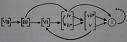 From left to right, the chords are VII, III, VI, vi and ii*, vii* and V, then i.
Kind of confusing looking, but basically, it's a guide line for chord movements in a minor key, and it includes both the Major and Diminished 7th.
From left to right, the chords are VII, III, VI, vi and ii*, vii* and V, then i.
Kind of confusing looking, but basically, it's a guide line for chord movements in a minor key, and it includes both the Major and Diminished 7th.Yeah your right my bad :P
When dealing with the minor Keys the sixth and seventh degrees are variable depending on if its in the natural, harmonic or melodic. So you are right the most common is
i ii* III i V VI vii
This incorperates the nautral,harmonic and melodic
So les_paul you could actuall play all these :P
i ii* ii III III+ iv IV v V VI #vi* VII vii* i (+ is augmented)
If you are just playing in the natural Key (Aeolian) then you can use
i iib5 III iv v VI VII
Thanks guys, this stuff just clicked in my head and started making since about a week ago. Now I want to learn as much as possible.
Once you understand this stuff, you can go just about anywhere. I don't really use it much, but understanding how music functions gives you so much insight into everything else.